The Beauty Business Operating System: How to Run Your Business Without Drowning in DMs, Diaries and Sticky Notes
Most people do not start a beauty business because they love administration.
They start because they are talented at what they do. They may be a brilliant nail technician, stylist, barber, aesthetic practitioner or beauty therapist. They want to work with clients, build a reputation and create a business of their own.
Then the business starts to grow!
More clients bring more appointments, questions, payments, stock orders and messages. Enquiries arrive through Instagram, Facebook, WhatsApp and text. Appointment details sit inside conversations. Important jobs are written on sticky notes. Customer preferences live in someone’s memory.
At first, this can feel manageable. When the business is small, you can remember most of what needs to happen.
The problem is that this way of working does not grow with you.
Eventually, your memory and attention become the system holding the business together. You spend the day delivering treatments and the evening trying to catch up with everything surrounding them.
This does not mean you are bad at business. It usually means the business has outgrown the informal way it was being run.
What you need next is a simple operating system.
What is a business operating system?
A business operating system is simply the way your business works.
It explains how enquiries are handled, how appointments are booked, where customer information is stored, how services are delivered, who is responsible for important jobs and how you know whether the business is improving.
This does not need to involve complicated software or a huge operations manual. For a solo beauty professional, it might consist of one booking system, one place for customer records, a few useful checklists and a regular weekly review.
As the business grows, the system grows with it. Processes become clearer, responsibility is shared and performance is reviewed across more people or locations. The basic principles remain the same.
These ideas are not new. Large businesses have used them for decades.
Lean Thinking focuses on delivering more value while removing wasted time and effort. The E-Myth encourages owners to build a business that does not depend entirely on them. EOS, the Entrepreneurial Operating System, organises businesses around clear direction, people, data, issues and repeatable processes. Kaizen focuses on making small, continuous improvements rather than waiting for one huge transformation.
The language can sound corporate, but the ideas are simple.
Understand what the customer needs. Give information a proper home. Make important work repeatable. Decide who owns what. Measure a few useful numbers. Keep improving.
This guide turns those principles into a practical operating system for a beauty business.
Get the business out of your head
The first step is to recognise how much of the business currently exists only in your memory.
You may be remembering that one customer needs a patch test, another asked to be contacted about a cancellation and a supplier needs chasing before the end of the week. None of these jobs is difficult on its own, but together they create a constant mental load.
Every important piece of information should have a proper home.
Appointments belong in the booking system. Customer details belong in a customer record. Jobs belong on a task list. Financial information belongs in your accounts. Instructions for recurring work belong in a simple process document.
The exact tools matter less than the rule: the business should not depend on somebody remembering everything.
Build around the customer journey
An appointment is only one part of the customer’s relationship with your business.
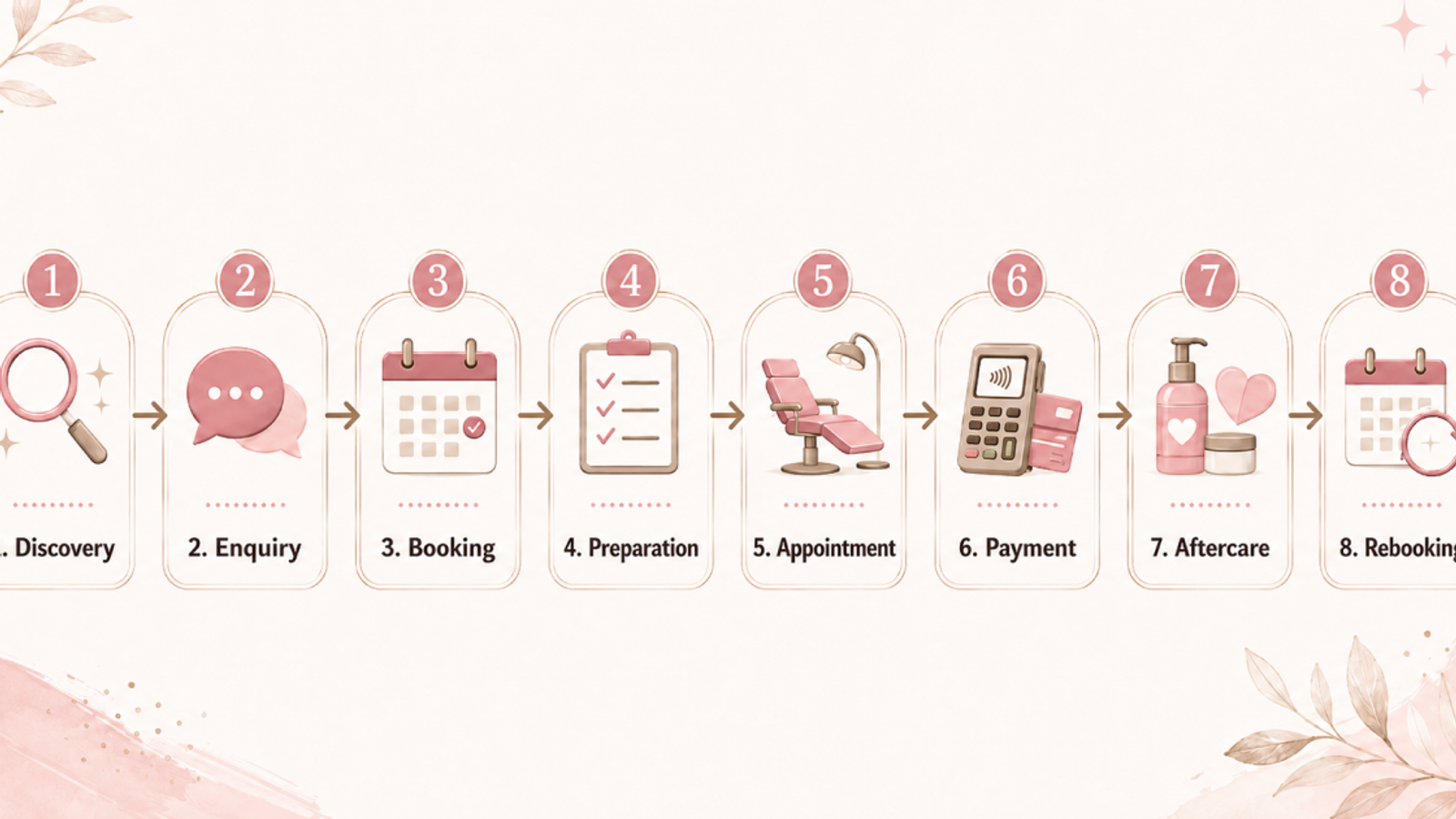
The full journey begins when they discover you and continues through their enquiry, booking, preparation, appointment, payment, aftercare and eventual return.
Write that journey down:
Discovery → Enquiry → Booking → Preparation → Appointment → Payment → Aftercare → Rebooking
Then look at each stage and ask what the customer needs, what the business needs to collect and who is responsible for making it happen.
For example, before a first appointment, the customer may need the time, location, price and preparation instructions. The business may need a deposit, consultation details and confirmation that any required patch test has been completed.
Mapping the journey helps you spot gaps before they become problems.
Use social media as a doorway
Social media is a good place for a conversation to begin. It is a poor place for important information to remain.
An enquiry may start on Instagram, but the confirmed appointment should move into the booking system. Treatment information should move into the customer record. A job that needs completing should become a task rather than sitting inside an unread message.
You should also decide when messages are handled. A solo practitioner might respond at two or three set points during the day instead of interrupting every treatment. A larger salon may give one person responsibility for monitoring enquiries.
Standard replies can also help with common questions about prices, parking, deposits, preparation and cancellations. They do not need to sound robotic. They simply prevent the team from repeatedly typing the same information.
Turn recurring work into simple processes
Most beauty businesses already have processes. They just have not written them down.
You probably have a usual way of opening the salon, preparing a treatment area, handling a late customer or placing a stock order. The process may currently exist as habit rather than something another person could easily follow.
A useful process only needs to answer four questions:
- What starts the task?
- Who owns it?
- What are the essential steps?
- What does finished look like?
Start with the work that causes the most disruption when it goes wrong. New-client preparation, cancellations, complaints, opening and closing, stock ordering and payment problems are usually good places to begin.
Do not try to document everything at once. Write down each process the next time you complete it, then improve it as you learn.
Standardise the service, not the personality
Standardisation does not mean making every appointment feel identical.
It means ensuring the important parts are consistently right, regardless of who is working or how busy the day becomes.
Each service should have a simple standard covering its duration, price, preparation, consultation requirements, products used, essential steps, aftercare and recommended return period.
This gives employees a reliable foundation while leaving room for personality, professional judgement and the individual relationship with the customer.
It also makes training easier. Instead of relying on somebody watching and gradually working things out, you can clearly explain how the business expects the service to be delivered.
Make returning part of the service
A sustainable beauty business is usually built on returning customers, not a constant supply of new ones.
Even happy customers can fail to return because they become busy, forget when they are due or are never given a clear next step. That means rebooking and retention should form part of the customer journey rather than being treated as occasional marketing.
At the end of the appointment, explain when the customer is likely to need the service again. Offer to arrange the next visit. Send a reminder when they are due and use loyalty to recognise repeat custom.
The important point is consistency. Returning should not depend on a member of staff remembering to mention it when the salon happens to be quiet.
Give money and stock their own systems
A full diary does not always mean a profitable business.
Every treatment takes time, uses products and contributes towards overheads such as rent, software, insurance, utilities and payment fees. If a service is priced only by looking at competitors, it may be popular while still failing to make enough money.
You do not need a complicated financial model. Start by understanding the approximate time and cost involved in delivering each service, then review whether the price reflects that reality.
Stock should follow a similar routine. Decide which products are essential, how many you normally need and at what point they should be reordered.
A simple rule is far more reliable than waiting until somebody notices that you are about to run out.
Measure a few useful numbers
You do not need a huge dashboard to understand whether the business is working.
Choose a small group of numbers that help you make decisions. These might include total sales, completed appointments, cancellations, diary utilisation, average customer spend, rebooking rate and the balance between new and returning customers.
The purpose is not to collect data for its own sake. Each number should help you ask a useful question.
If bookings are increasing but profit is not, are some services under-priced? If new customers are rising but returning visits are falling, is something going wrong after the first appointment? If one treatment is constantly full, should more capacity be created for it?
Five useful numbers reviewed every week are better than fifty reports you rarely open.
Create clear ownership
When you work alone, you are responsible for everything. You are the practitioner, receptionist, marketer, stock controller, bookkeeper and business owner.
It can still help to think of these as separate roles. This shows you where time is being spent and which responsibilities could eventually be handed to somebody else.
As the team grows, every important area should have a clear owner.
A receptionist might own appointments, deposits and reminders. A senior practitioner might own service standards and product usage. A salon manager might own the daily diary, complaints and team coordination.
Several people can contribute, but one person should know they are ultimately responsible for the outcome.
Without ownership, important jobs tend to sit in the space between people.
Create a weekly operating rhythm
Processes explain how work is done. An operating rhythm gives you time to check whether the business is working.
At the end of each day, complete a short close. Make sure payments and customer notes are complete, tomorrow’s appointments are prepared and any outstanding problems have been captured.
Once a week, set aside time to review the numbers, upcoming appointments, staffing, stock and any unresolved issues.
For a solo business, this might only take 30 minutes. It is still important because it creates protected time to work on the business rather than spending every available hour working in it.
Once a month, step back further and review profitability, customer retention, service performance and capacity.
Fix the system, not just the problem
Every business experiences missed messages, late appointments, stock shortages and unhappy customers.
The purpose of an operating system is not to make problems disappear completely. It is to help the business learn when something goes wrong.
When the same issue keeps happening, ask what in the process allowed it to happen.
If consultation forms are regularly incomplete, perhaps they are sent too late or nobody is checking them. If stock keeps running out, perhaps there is no reorder level or nobody clearly owns the stock check.
This is where continuous improvement becomes practical.
Choose one problem, change the process and see whether the result improves. Small improvements made regularly are more useful than a perfect manual nobody follows.
Let the system grow with the business
A solo practitioner needs a lightweight operating system. You need clear places for appointments, customer information, tasks, money and basic procedures.
When you hire your first employees, the emphasis changes. Processes need to be written down, responsibilities need to be assigned and service standards need to be taught.
When you expand across multiple teams or locations, visibility becomes more important. Managers need clear ownership, while the owner needs reliable information without being involved in every appointment or decision.
The system does not need to be replaced every time the business grows. It simply becomes more detailed and is shared between more people.
Your minimum viable beauty business operating system
You do not need to redesign the entire business before you begin.
A useful first version only requires six things:
- One recognised place for appointments and customer information.
- A written journey from first enquiry to repeat visit.
- Simple processes for the recurring jobs that cause the most disruption.
- Clear ownership of every important part of the business.
- A small weekly scorecard containing the numbers that matter.
- A regular review where you solve one problem and improve one process.
Technology can support all of this, but technology is not the operating system by itself.
A booking platform does not automatically create a good booking process. Accounting software does not create financial discipline. A loyalty programme does not guarantee that customers will return.
The process comes first. The software should make that process easier to follow.
Build a business that does not rely on memory
The purpose of an operating system is not to turn a personal, creative beauty business into a cold corporation.
It is to protect the parts of the business that matter.
When routine administration is organised, you have more time for customers. When expectations are clear, employees feel more confident. When information is visible, decisions become easier. When the business does not rely entirely on your memory, it becomes possible to take time away, develop the team or prepare for the next stage of growth.
The principles behind Lean, The E-Myth, EOS and continuous improvement may come from much larger organisations, but they apply just as well to an independent beauty professional.
Understand what the customer needs. Give important information a home. Make recurring work repeatable. Decide who owns what. Measure a few useful results. Improve the process when problems return.
You do not have to implement everything at once.
Start with the part of the business creating the most noise. Move it out of your head, give it a clear home and decide how it should work.
Then improve the next thing.
A successful beauty business does not rely on its owner remembering everything.